913 South College Road, Suite 108, Lafayette, LA 70503



At Erin Fontenot, DDS, we utilize advanced clinical testing through OralDNA® Labs to provide a deeper understanding of your oral health. OralDNA® Labs is a leader in salivary diagnostics, offering reliable, science-driven testing that helps detect and assess disease at earlier, more manageable stages. This allows us to move beyond surface-level evaluations and deliver more precise, proactive care.
Your oral health plays a critical role in your overall wellness. By incorporating OralDNA® testing into our approach, we are able to identify harmful bacteria, screen for oral HPV, and develop highly personalized treatment plans. This level of insight helps us improve outcomes, reduce long-term risks, and support your health with greater accuracy and confidence.
The health of your mouth is closely connected to the health of your entire body. Research has shown that oral bacteria can contribute to serious conditions such as heart disease, diabetes, stroke, and complications during pregnancy. OralDNA® testing allows us to identify the specific bacteria associated with periodontal disease and evaluate how they may be impacting both your oral condition and your overall health.
When harmful bacteria are present at elevated levels, especially in combination with an individual’s inflammatory response, they can lead to symptoms such as bleeding gums, bone loss, and eventual tooth loss. Over time, these same bacteria may also increase the risk of broader health concerns, making early detection and management essential.
The OralDNA® test is simple, comfortable, and non-invasive. During your visit, you will rinse with a sterile saline solution to collect bacteria from throughout your mouth. You will then provide a small saliva sample in a collection tube. The sample is carefully sealed and sent to a certified laboratory for advanced molecular analysis. There are no needles, no discomfort, and the entire process takes only a few minutes.
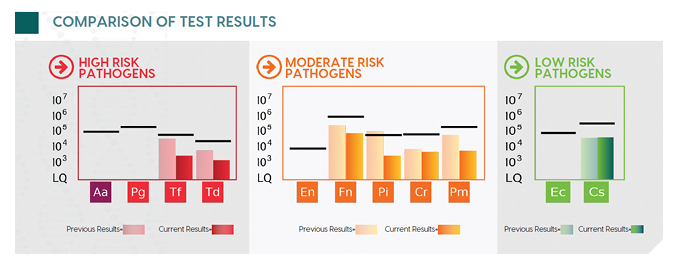
Once your results are returned, we will review them with you in detail. You will gain a clear understanding of which bacteria are present, what they mean for your oral and overall health, and how your treatment plan will be tailored moving forward. Our goal is to provide clarity, not confusion, so you can make informed decisions about your care.
Your comfort and privacy are always a priority. Before testing, we will guide you through a simple consent process and answer any questions you may have. Every step is handled with discretion and care, ensuring you feel confident and informed throughout the experience.
Some OralDNA® tests may be eligible for partial coverage through dental or medical insurance plans. Our team is happy to review your benefits, verify eligibility, and discuss your options so you can move forward with confidence.
OralDNA® Labs provides molecular salivary diagnostics that identify specific microbes and viral markers associated with oral disease. Unlike traditional visual exams or X-rays, salivary tests detect genetic material from bacteria and viruses, offering a deeper look at the microbial environment in the mouth. These results help clinicians detect risk earlier and tailor prevention or treatment strategies based on objective laboratory data.
Salivary diagnostics are noninvasive and focus on the biological causes of disease rather than only the signs or damage that has already occurred. By identifying microbial profiles and viral presence, clinicians can move beyond symptom-based care to targeted interventions. This approach supports more precise monitoring of treatment response and long-term risk management.
We use OralDNA® testing to supplement clinical exams with laboratory-grade data that clarifies a patient’s microbial risk factors. Integrating these tests allows us to identify periodontal pathogens and viral markers that may not be visible during a routine exam, which supports earlier and more informed treatment planning. This evidence-driven perspective helps us create personalized care pathways for prevention, periodontal therapy, and implant planning.
OralDNA® results are especially valuable when a patient presents with persistent inflammation, recurrent infections, unexplained bleeding, or a history of periodontal disease. The information guides decisions about antimicrobial therapies, localized treatments, and frequency of monitoring. Ultimately, the testing enhances our ability to protect both oral health and related systemic concerns through targeted interventions.
OralDNA® testing can identify periodontal pathogens linked to gum disease and detect viral markers such as oral human papillomavirus (HPV) that may have clinical significance. Knowing which organisms are present and at what levels helps clinicians classify disease risk and choose therapies that address the underlying causes rather than only treating symptoms. This can influence recommendations for deep cleaning, localized antimicrobial treatment, or more intensive periodontal care.
Test results also inform prevention strategies, including tailored hygiene instruction, more frequent maintenance visits, and targeted antimicrobials when appropriate. For patients pursuing implants or complex restorative work, microbial profiling helps assess infection risk and optimize pre- and post-procedure management. By aligning treatment with laboratory findings, care becomes more precise and outcome-focused.
The OralDNA® sample collection is simple, noninvasive, and quick. Patients typically rinse with a sterile saline solution and then provide a small saliva sample into a collection tube under the supervision of a clinician, and there are no needles or invasive swabs required. The entire collection process usually takes only a few minutes and is well tolerated by most patients.
After collection, the sample is sealed and sent to a certified laboratory for molecular analysis using validated techniques. Our team explains each step, obtains informed consent, and answers questions to ensure patient comfort and understanding. We aim to make the experience straightforward while delivering laboratory-quality data to support your care.
OralDNA® uses molecular methods such as DNA-based assays that are highly specific for detecting microbial and viral genetic material. These technologies are designed to minimize false positives and provide reproducible identification of targeted organisms, giving clinicians reliable information on which to base clinical decisions. Results are generated by specialized laboratories with quality controls and standardized reporting formats.
When results return, our team reviews the findings in the context of your clinical exam, dental history, and risk factors to produce a comprehensive interpretation. We translate laboratory data into actionable recommendations and clearly explain what the results mean for your oral and overall health. This combined clinical-lab approach supports evidence-based care and informed patient decision-making.
Identifying specific periodontal pathogens helps clinicians determine the intensity and type of periodontal therapy needed, such as scaling and root planing, adjunctive local antimicrobials, or systemic management strategies. For patients with high-risk microbial profiles, treatment plans may emphasize more aggressive or closely monitored interventions to control infection and inflammation. The test results also help prioritize follow-up intervals and maintenance care to reduce recurrence risk.
In implant planning, microbial profiling can inform timing and preparatory steps to reduce the likelihood of post-procedure complications like peri-implantitis. Addressing bacterial risk before placing implants improves the chances of long-term stability and success. By integrating OralDNA® data, clinicians can tailor surgical and restorative protocols to the patient’s individual microbial risk.
Yes, certain OralDNA® tests screen for oral human papillomavirus (HPV), which can be an important marker in oral health examinations. Detecting high-risk HPV strains may prompt closer monitoring and, when appropriate, referral for further medical evaluation, because persistent infection with some HPV types has been associated with oropharyngeal disease. Early identification allows the dental team and medical partners to develop a coordinated surveillance plan.
Discussing HPV test results is done sensitively and with patient education about what a positive or negative result means in the clinical context. Results do not automatically indicate disease but inform a risk-based approach to follow-up and prevention. Our goal is to provide clear information and support appropriate next steps while respecting patient privacy and comfort.
Oral microbial imbalance and active periodontal infection have been associated with systemic conditions such as cardiovascular disease, diabetes, and adverse pregnancy outcomes in scientific literature. OralDNA® testing helps identify pathogenic bacteria that may contribute to chronic inflammation, allowing clinicians to address oral sources of risk as part of comprehensive health care. While testing does not diagnose systemic disease, it contributes valuable information to an overall wellness strategy.
When results indicate elevated levels of harmful bacteria or notable viral markers, we coordinate recommendations that may include medical collaboration, enhanced periodontal therapy, and targeted prevention. This integrated perspective emphasizes the mouth-body connection and supports proactive measures to protect both oral and general health. Clear communication ensures patients understand how oral findings may relate to broader health considerations.
Patient comfort and confidentiality are priorities throughout the testing process, from informed consent to delivery of results. Samples and reports are handled with discretion, and results are discussed privately with patients in a clear, respectful manner to ensure understanding and informed decision-making. Our team follows established privacy practices to safeguard your information and address any questions you may have about data handling.
When test findings require follow-up care or coordination with other providers, we obtain the necessary permissions before sharing information and explain the reasons for any recommended referrals. Patients receive a thorough review of results and a personalized plan for next steps, including monitoring or treatment options. This approach helps patients feel informed and supported while maintaining strict confidentiality.
Preparation for OralDNA® testing is minimal; patients are generally asked to avoid eating, drinking, smoking, or performing oral hygiene for a short period before collection to ensure an accurate sample. Specific pre-test instructions are provided at the time of scheduling to optimize sample quality and test reliability. The collection itself is brief and noninvasive, making it convenient to add to a routine visit when indicated.
Patients should consider OralDNA® testing if they have persistent gum inflammation, bleeding, a history of periodontal disease, unexplained bone loss, recurrent infections, or concerns about oral HPV exposure. It is also useful for patients planning implants or extensive restorative work who want to assess microbial risk in advance. Discussing your individual concerns with the dental team will clarify whether testing is appropriate and how results could influence your care plan.